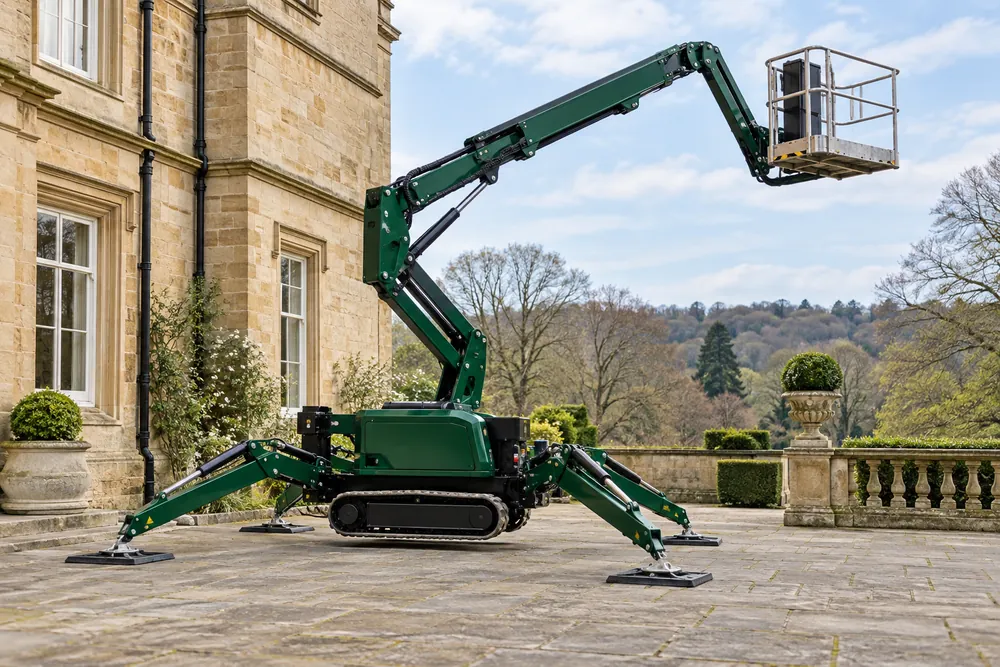
Compact Access For Awkward Sites
A spider lift combines a compact base with an extending boom and stabilising legs. Many models use tracks to travel to the work position. They are useful to consider where an ordinary self-propelled boom cannot pass through the entrance, but access width alone does not establish that the machine is suitable.
Typical enquiries involve enclosed courtyards, building maintenance and work inside large halls. The machine’s transport dimensions, operating envelope and ground loads all need checking. Tell us whether there are steps, changes in level or fragile finishes along the route. A compact machine still carries significant weight and needs a properly assessed route into place.
Measure More Than The Gateway
Measure the narrowest width and lowest clearance along the full route. Include corners, door closers, internal lobbies and any ramp transitions. A straight entrance measurement can be misleading if the machine must turn immediately after it passes through, or if the ground falls away beyond the doorway.
Ask for the transport height and width of the actual proposed model. Some machines change configuration for travel, so the supplier must explain what is needed on site. Provide photographs of both sides of each restriction and identify any surfaces that cannot accept tracks. Plan a clear return route too, especially if other work will change the site during hire.
Allow Space For Stabilising Legs
A narrow travelling machine can need a much wider footprint when set up for lifting. The legs must be positioned as required by the manufacturer, with ground support assessed at each contact point. Paving slabs, covers and garden surfaces need attention rather than an assumption that a light-looking machine is harmless.
A suitable load-spreading arrangement depends on the machine forces and ground capacity. Do not choose support pads from appearance alone. IPAF’s compact lift guidance discusses the importance of stabiliser setup. A competent assessment is particularly useful where access leads across a suspended surface or where the ground construction is uncertain.
Power And Safe Working Arrangements
Spider platforms may have different power options for travel and platform operation. If the job is inside a hall or enclosed courtyard, explain the ventilation, noise and electrical-supply constraints. Confirm which functions need mains power or battery charging, and where cables can run without creating another hazard.
LOLER and PUWER duties still apply to compact platforms. Their small size does not remove the need for training, examination, familiarisation and a planned rescue method. Confirm the correct operator category for the proposed machine and keep the ground controls reachable. Choose the fall-protection arrangement through the risk assessment and manufacturer’s instructions before the platform is used.
Price The Full Access Problem
Spider lift hire costs depend on required reach, transport dimensions, operating footprint, power options and duration. Delivery complexity and operator provision can change the quotation. If a site assessment is proposed, establish its scope and any charge before it takes place, then agree the machine and working method in writing.
Make the enquiry specific about the building, task and access route. A photograph with measured dimensions is more useful than saying access is tight. If you have an open yard and no narrow entrance, conventional boom lift hire may also be worth comparing. For a direct overhead indoor task, review electric scissor lifts.
Your Hire, Step By Step
- 01
Describe The Job
Tell us the site location, dates and task for your spider lift hire enquiry. Include measured height, reach and the load or people involved.
- 02
Check The Site And Specification
Review the route, ground and proposed machine with the supplier. Resolve unknown dimensions and agree operator, delivery and working arrangements before booking.
- 03
Handover, Use And Collection
Accept the machine with its instructions and relevant records. Complete familiarisation and checks, use it within the agreed limits, and follow the supplier’s off-hire procedure.
Spider Lift Hire Questions
Will A Spider Lift Fit Through A Standard Door?
A spider lift may fit through a doorway, but there is no single standard machine width or height. Measure the clear opening and turning space, including any closer or threshold obstruction. The supplier must check the actual model in its travel configuration, plus floor capacity and the route beyond the door.
Can A Spider Lift Work On A Lawn?
A spider lift needs assessed ground support for both travelling and stabiliser setup. Tracks do not make soft ground suitable, and a lawn can conceal weak soil, drainage or services. Explain the surface and access route before hire so a competent person can decide whether protection, preparation or another access method is needed.
Does A Spider Lift Need An Operator?
A spider lift needs a trained and competent operator familiar with its controls and setup. Tell us if you need operated hire or intend to use your own operator. Confirm the machine category, stabiliser procedure, fall protection and emergency arrangements, with a ground person available as required by the site plan.