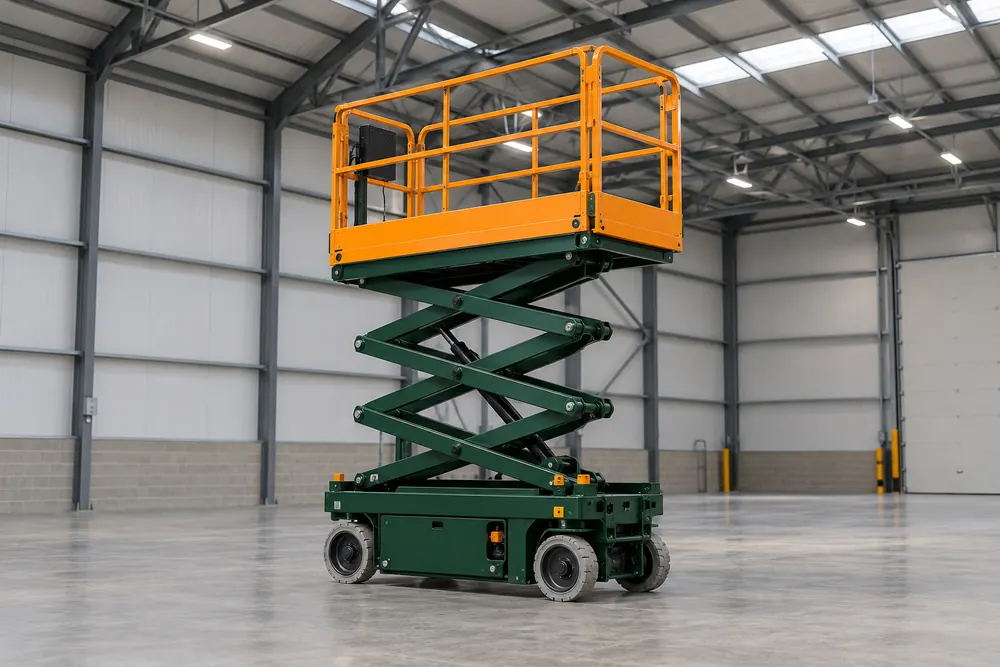
A Platform For Work Directly Overhead
A scissor lift raises its work deck vertically, giving a working area for tasks such as lighting replacement, overhead cable installation, decorating and ventilation maintenance. It suits jobs where the machine can stand beneath the work. It does not provide the sideways reach of an articulated boom.
Think about the whole work sequence when selecting the platform. A long installation run may need repeated repositioning and a clear travel route. Large materials need a suitable handling plan rather than being balanced across the guardrails. Tell us how many people will work from the deck and which tools or components need to travel with them.
Electric Or Rough-Terrain Scissor Lift
Electric scissor lifts are commonly considered for indoor work where exhaust emissions are unsuitable. Check charging arrangements, the available electrical supply and where the machine can be left safely between shifts. Non-marking tyres can be useful on finished floors, but they do not remove the need to assess surface protection.
An outdoor task may call for a model designed for that environment. Rough-terrain capability does not mean unrestricted use on soft or sloping ground. Ask the supplier to check the proposed surface and the manufacturer’s operating limits. A machine restricted to indoor use must not be taken outside simply because the weather seems calm.
Check The Floor And The Route In
Measure doorway height and width with the platform in its transport configuration. Include turns, loading doors, ramps and any changes in level along the route. A machine that fits through an entrance can still be too heavy for a floor or unable to turn into the work area.
Floor loading needs careful attention on suspended slabs, basements, raised floors and loading bays. Ask the building manager for structural information where necessary. Check concentrated wheel loads rather than relying only on total machine weight. Identify covers, voids and weak areas before deciding on a route, and avoid placing the machine where its load capacity has not been established.
Safe Use, Familiarisation And Fall Protection
The Provision and Use of Work Equipment Regulations 1998, known as PUWER, cover suitability, maintenance and operator instruction. Your planned use and the specific machine both matter. The HSE PUWER guidance explains the duties for work equipment.
A scissor lift normally relies on its guardrails for fall protection. Follow the task risk assessment, site rules and manufacturer’s instructions when deciding whether extra equipment is needed. IPAF fall-protection guidance distinguishes vertical platforms from boom-type machines. Never climb the rails or add a ladder to gain extra height.
Compare The Full Hire Scope
Scissor lift hire costs depend on working height, platform size, indoor or outdoor specification and hire duration. Delivery and collection can be a significant part of a short booking. Ask about charging, cleaning, damage terms and how the end of hire must be notified so collection arrangements are clear.
Book around the building programme, including the time needed to clear the floor and move stock. Confirm that someone can accept delivery and complete the handover. If obstructions prevent positioning directly below the work, review articulated boom lift hire instead. Our MEWP selection guide explains the wider choice.
Your Hire, Step By Step
- 01
Describe The Job
Tell us the site location, dates and task for your scissor lift hire enquiry. Include measured height, reach and the load or people involved.
- 02
Check The Site And Specification
Review the route, ground and proposed machine with the supplier. Resolve unknown dimensions and agree operator, delivery and working arrangements before booking.
- 03
Handover, Use And Collection
Accept the machine with its instructions and relevant records. Complete familiarisation and checks, use it within the agreed limits, and follow the supplier’s off-hire procedure.
Scissor Lift Hire Questions
Is An Electric Scissor Lift Suitable Indoors?
An electric scissor lift can suit indoor work when the floor capacity, entrance dimensions and working height match the machine. Confirm the permitted environment and charging requirements with the supplier. Finished floors may also need protection, and the operating area must remain clear of pedestrians, stock and overhead obstructions during use.
Do I Need A Harness In A Scissor Lift?
Harness use in a scissor lift depends on the risk assessment, manufacturer’s instructions and site requirements. IPAF says fall protection is not normally necessary in vertical lifts, where guardrails provide collective protection. Do not copy boom-lift practices without checking the machine and task, and never attach equipment to an unsuitable anchor.
Can A Scissor Lift Be Used On A Slope?
A scissor lift must stay within its manufacturer’s limits for travelling, positioning and elevating. The maximum travel gradient is not permission to raise the platform on that slope. Explain any ramps or sloping work areas before hire so the supplier can check whether the proposed model and working position are suitable.